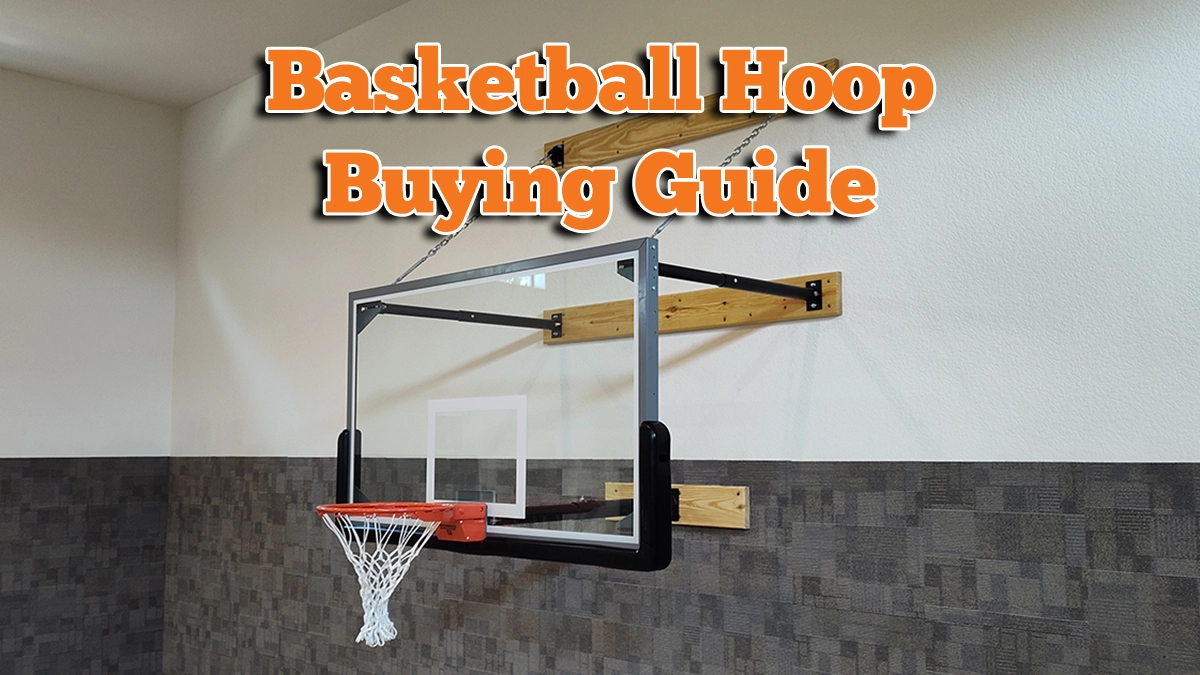
Wall Mounted Basketball Hoop Buying Guide
Wall Mounted Basketball Hoop Buying Guide
There are numerous options for wall mounted basketball goals. But, we’re only going to focus on hoops with sturdy glass backboards and spring rims. Those goals which are lightweight and flimsy are not covered in this buying guide. To simplify things, we’re going to break it down to 4 main categories. This wall mounted basketball hoop buying guide will address the benefits and limitations of each type.
Narrow Offset Residential

These wall mount hoops are generally equipped with 60” to 72” glass backboards, spring rims, and backboard pads. They typically provide an offset from the wall of 24” to 36”. Most designs provide rim heights of 6’ up to 10’. These goals are a fine option for players just looking to practice free throws and 3 point shots. However, they’re not well suited for lay ups or dunks, as the offset from the wall is unsafe. The other concern with this style of goal is that the wall attachment points are too close together. This concentrates all of the weight of the goal into a small portion of the wall, rather than spreading the load over a larger area. Unfortunately, this led to a horrible death in 2018, when one of these types of hoops fell off a wall and killed a 14 year boy. You can read more about this story here. Due to our safety concerns about this type of basketball hoop, we do not offer this option to our customers.
Stationary Wall Mount with Optional Height Adjuster

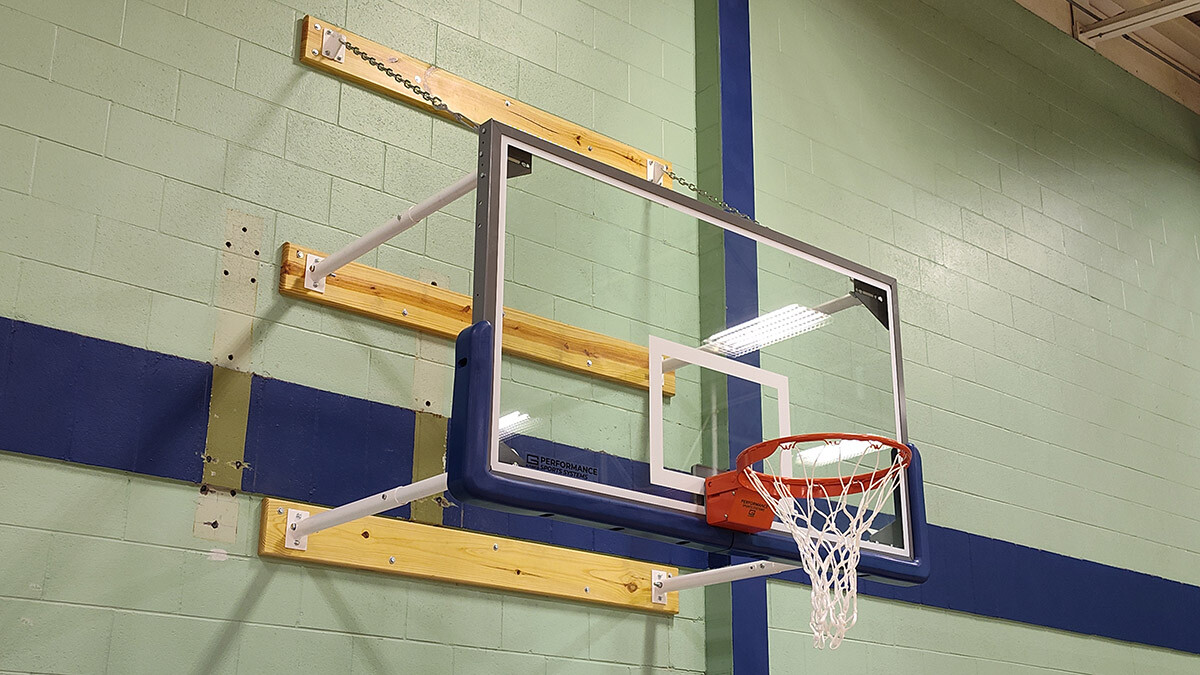
The stationary wall mount goal is the most popular option for serious athletes who don’t want any performance reduction. These goals are outfitted with professional glass backboards and come with numerous rim options. And, unlike the residential hoops listed above, the stationary wall mounts are capable of having offsets from the wall of up to 12’. These goals are designed for all levels of play, from grade school children to NBA pros.
3 Point vs 4 Point Backstop
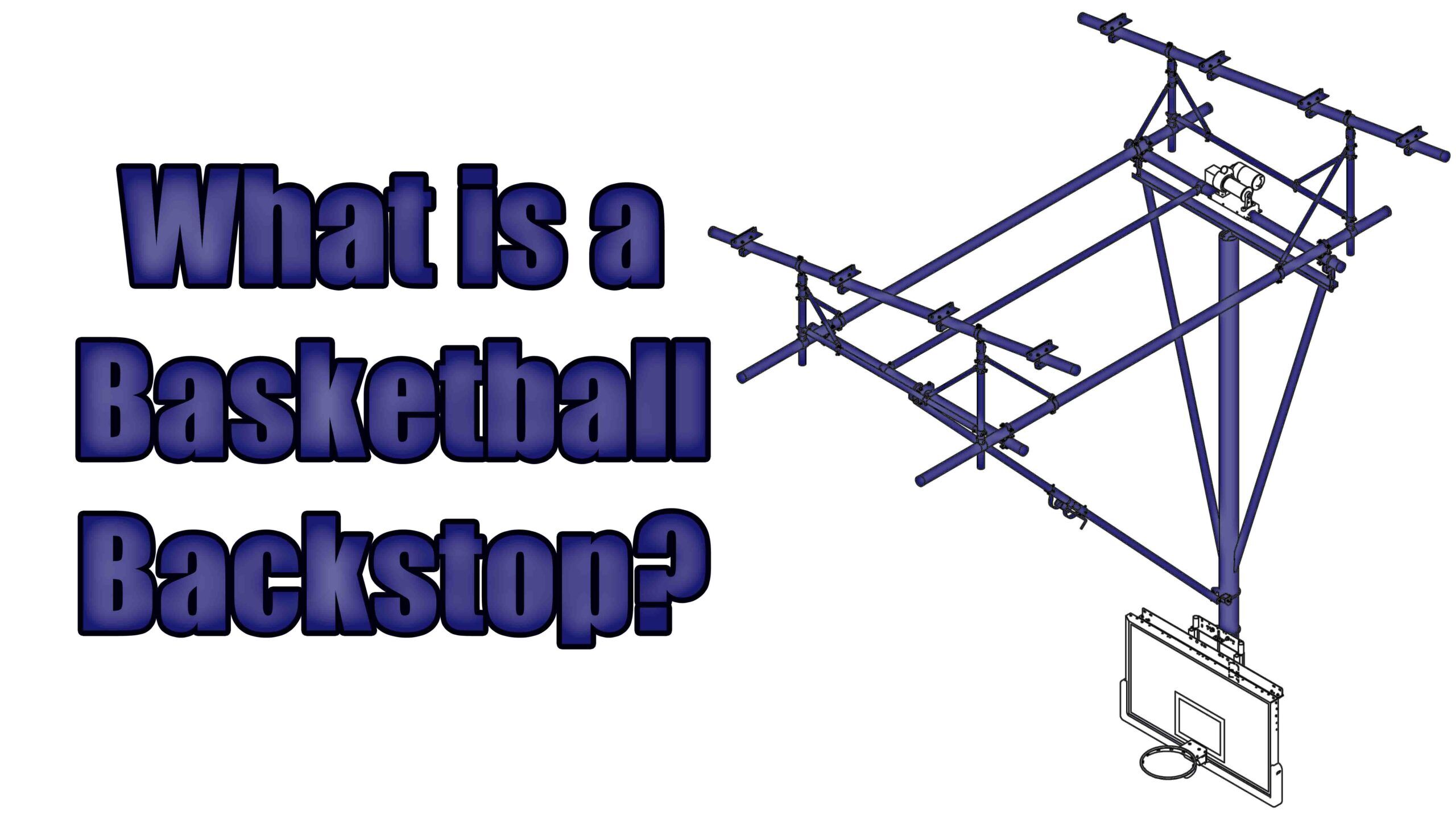
The wall attachment framework is available as a 3 point or 4 point connection. With the 3 point design, 2 pipes connect the upper corners of the backboard, while a 3rd pipe connects at the bottom, directly behind the rim. This is the strongest possible configuration, as all of the load on the rim is carried by the backstop, rather than by the backboard. The 4 point connection is not as strong, as there is no backstop framework behind the rim. With the 4 point design, the corners of the backboard are supported. To the casual observer, 4 seems better than 3. However, support behind the rim is superior to support at the lower corners, since all of the load is applied to the rim. Providing support behind the rim reduces the risk of shattering glass. Indeed, we have never had a glass backboard shatter with a 3 point backstop or when a height adjuster is added. See Height Adjuster below.
Side Fold Wall Mount with Optional Height Adjuster
The side fold wall mount hoop is a great option when the gym is mixed use. This system includes the same high performance backboards and rims as the stationary wall mount, but with the added feature of folding the backboard close to the wall. These units can be installed to fold either to the right or to the left. And, the wall offset can be anywhere from 4’ up to 12’. The backstop on side fold systems are 4 point, which connect to the corners of the backboard. Therefore, we only recommend a side fold hoop with a strong steel framed backboard or with a height adjuster. The LXP4200 steel framed glass backboard from Gared Sports provides the greatest strength of any backboard on the market today. Indeed, we have never seen this model shatter. Adding a height adjuster provides additional support to reduce the shatter risk. Please see the height adjuster section below. These goals are designed for all levels of play, from grade school children to NBA pros.
Fold Up Wall Mount with Optional Height Adjuster
The fold up wall mount goals are another great option for mixed use facilities. Fold up systems include the same high performance backboard and rim options as the stationary wall mount and side fold mount systems. But, unlike the other goals in this wall mounted basketball hoop buying guide, fold up units require a winch or hoist to raise and lower the backboard. The hoist is available as a manual worm gear winch or an electric hoist. The wall offset for a fold up basketball goal can be anywhere from 4’ up to 12’. The backstop on fold up systems are 4 point, which connect to the corners of the backboard. Therefore, we only recommend a fold up system with a strong steel framed backboard or with a height adjuster. The LXP4200 steel framed glass backboard from Gared Sports provides the greatest strength of any backboard on the market today. Indeed, we have never seen this model shatter. Adding a height adjuster provides additional support to reduce the shatter risk. Please see the height adjuster section below. These goals are designed for all levels of play, from grade school children to NBA pros.
Worm Gear Winch vs Electric Hoist
If cost is the only consideration, then go with a worm gear winch. However, for ease of use, there’s no beating the electric hoist. Aside from the cost difference, you should also consider these items when trying to choose between manual and electric:
- Frequency – are you frequently raising and lowering your backboard? If yes, then the electric hoist is quick and easy to operate, as the motor is powered on and off with a key switch. On the other hand, the worm gear winch is manually operated with a hand crank. It can also be operated with a modified slow speed high torque electric drill. But, this requires a power cord and the drill. A light weight stock battery powered drill will not suffice. This video shows operation with an electric hoist.
- Wiring – If running wiring to the electric hoist is not possible, then the manual worm gear winch is the only option. The electric hoist is outfitted with a 4 prong twist lock plug that fits a corresponding 4 prong twist lock outlet. Power to the outlet is controlled by the key switch mounted elsewhere in the wall. Adding the necessary junction boxes and wiring is a piece of cake, if done during building construction. But, adding these things after construction is more difficult. This type of work may also requires the services of a licensed electrician, depending upon the building codes in your area.
Optional Height Adjusters
The height adjusters available for the wall mount basketball goals are available as manual or electric. The height adjusters lower the rim from 10’ to 8’ and can be stopped at any point in between. The manual height adjusters are operated with a long hook that engages the bottom of the height adjuster. The electric systems come with a motor and key switch and operate similarly to the electric hoists used on the fold up goals. You can see this functionality in this video.
Height Adjusters incorporate a Direct Mount Bracket. This is a industry term used to describe a mounting configuration where the rim bolts pass through the backboard and into a structural bracket. Forces applied to the rim are transmitted into the direct mount bracket, which greatly reduces the risk of shattered glass. Indeed, we are unaware of any of our clients who have had broken glass when a direct mount bracket and height adjuster are installed.
Height adjusters can be added to any of the stationary, side fold, or fold up hoops. All of the wall mount packages provide the option to add a height adjuster.
Additional Resources
Ordering a Wall Mounted Basketball Hoop
If you’ve read every line in this wall mounted basketball hoop buying guide, then you may think that ordering a quality wall mounted system might be confusing, due to all the options. But, we make it super simple. Whether you want stationary, side fold, or fold up, we’ve provided almost every option in simple packages with multiple choice layout. These packages provide options for wall offset, backboard type, colors, and height adjusters. The packages include everything other than the bolts or screws used to anchor the systems to the wall. This hardware is sourced locally by the client based on the type of wall to which they are anchoring. Packages with electrical components include the motor twist lock plugs, wall outlets, and key switches. Junction boxes, conduit, and wiring is not included as these items are provided by your electrical contractor.
Hoop vs Goal
You may have noticed throughout this wall mounted basketball hoop buying guide that we use the term “Hoop” and “Goal”. If you’re wondering what the difference is, there isn’t one. We have clients across the United States and even some international customers. We find that people in different regions use different words to describe the exact same thing. For our purposes, we use hoop and goal interchangeably to describe the entire structure, including the backstop, backboard, and rim. Some people will disagree and argue that the goal or hoop is only the rim itself and that goal and hoop do not include the backboard or any other parts.
Installation Expertise
We’ve installed hundreds of basketball goals, maybe over a thousand. We’re not keeping count. If you need additional guidance, we’re just a phone call away, or you can leave a question on our contact us page. You may also find additional resources at SouthTexasSportCourt.com or GaredPerfSports.com